

There’s a specific kind of frustration that hits founders around month eight of running a YouTube channel. The videos keep going out. The team keeps hitting deadlines. And the needle on actual revenue? It hasn’t moved. Before you blame the editor or the algorithm, consider a harder possibility: the channel is active, but it was never strategic — and those are two very different things. Confusing them is where most brands quietly burn budget, because a business YouTube strategy isn’t defined by output. It’s defined by clarity.
We see this pattern constantly in established eCommerce brands. YouTube feels urgent. There’s pressure to upload, pressure to feed the algorithm, pressure to stay visible. So teams start producing before anyone answers the questions a real business YouTube strategy depends on: Who is this channel for? Where are they in their buying journey? And what job is this channel doing for the business?
When Weekly Uploads Stop Meaning Anything
Skip those questions and the content turns reactive. A how-to video one week, a trend clip the next, a product demo when someone remembers. Nothing connects, so the channel drifts — not from laziness, but because no strategy ever held it together.
This is the trap of content consistency vs business results: they don’t automatically travel together. You can publish weekly for years while attracting the wrong viewers and generating traffic that never touches a purchase decision. It’s also the honest answer to why business YouTube channels underperform — the weakness is almost never production quality. It’s that the channel has no strategic identity. It doesn’t know who it’s for, so no one watching knows either.
We break down the full argument in this video:
Rebuilding Clarity Into Your Channel, Step by Step
Fixing this doesn’t require more output. It requires a business YouTube strategy built on answers, not assumptions:
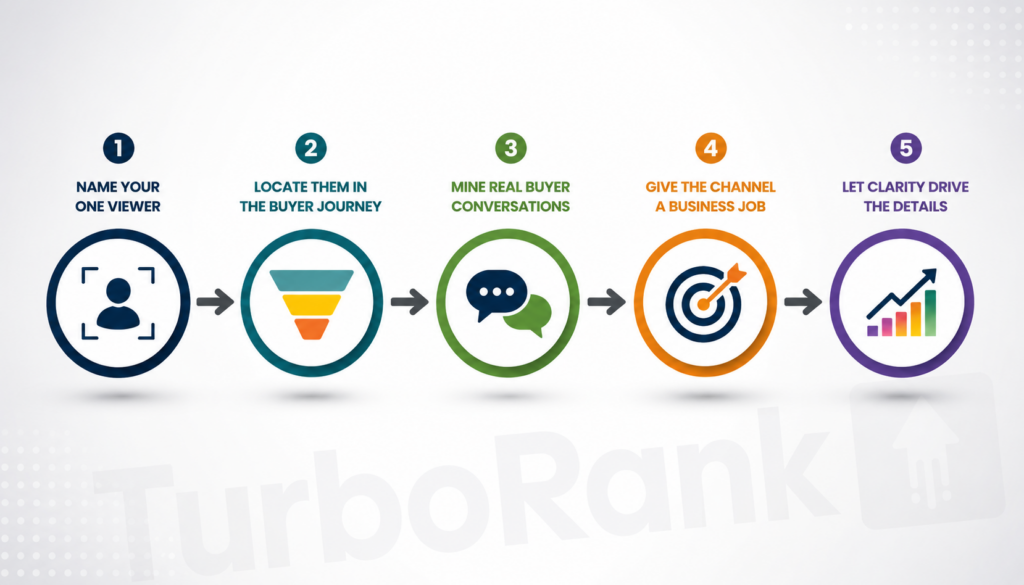
Step 1: Name your one viewer. Get specific about the operator you serve — their revenue stage, their stack, their pain. This becomes your YouTube channel audience strategy, and it sharpens everything downstream.
Step 2: Locate them in the buyer journey. Someone discovering a problem needs different videos than someone comparing providers. Know which stage each video serves.
Step 3: Mine real buyer conversations for topics. Sales calls, support tickets, pre-purchase questions — the conversations that actually move decisions forward are your content roadmap.
Step 4: Give the channel a business job. Demand generation, shorter sales cycles, pre-call trust — pick its role, then measure against that instead of views.
Step 5: Let clarity drive the details. With clean targeting, topic selection, messaging, titles, and thumbnails all improve on their own.
From there, the next lever is picking the right topics — which we cover in the other blog entitled “How to Choose YouTube Topics That Actually Drive Revenue”.
A Calendar Schedules. A Strategy Decides.
The deeper shift is content strategy vs content calendar. The calendar answers when; only strategy answers why and for whom. That distinction matters more now than ever, because AI is flooding every platform with content — and more content doesn’t buy more trust. The winning channels aren’t the loudest ones. They’re the clearest. A focused YouTube content strategy for businesses lets every video compound on the last, and channels that feel intentional are the ones buyers believe.
Turn Activity Into an Asset
At TurboRank, we help brands replace random uploading with a YouTube content strategy for businesses that actually compounds — audience definition, intent-driven topics, and optimization. Our Free Quick Fix Audit shows you exactly where your channel is leaking commercial value.
Frequently Asked Questions
We post consistently — why isn’t the channel growing the business?
Consistency without clarity produces activity, not results. If the channel lacks a defined audience and business role, uploads attract low-intent traffic that never supports buying decisions.
What separates strategic channels from active ones?
Strategic channels are clear on three things: who they serve, what problems that audience is solving, and how the content moves viewers toward a decision.
Will AI-generated content volume solve this faster?
No — AI makes volume cheap for everyone, which makes clarity the differentiator. Trust goes to the channels with the sharpest positioning, not the biggest output.
How does TurboRank fit into this?
We deliver YouTube SEO and marketing for established eCommerce brands — audience strategy, intent-based topic research, content planning, and optimization. Our Free Quick Fix Audit is the quickest way to see where your channel stands.
Matthew Pearce has been at the forefront of YouTube growth since 2007, when he was first hired to produce viral video content. With over a decade of hands-on experience, he’s helped launch hundreds of successful YouTube channels and driven millions in direct sales through the platform. As a strategist and content developer, Matthew specializes in turning creative vision into scalable growth. He also leads a weekly YouTube series, offering marketers expert insights on emerging trends and what actually moves the algorithm.