

Most enterprise YouTube channels don’t have a production problem. They have a topic problem. Teams invest heavily in editing, thumbnails, and publishing cadence, yet the channel still fails to influence pipeline. The reason is simple: topic selection is strategy. A buyer intent content strategy — one built around what buyers are trying to figure out and how close they are to acting — is the highest-leverage decision your channel will ever make. Get YouTube topic selection right, and everything downstream gets easier.
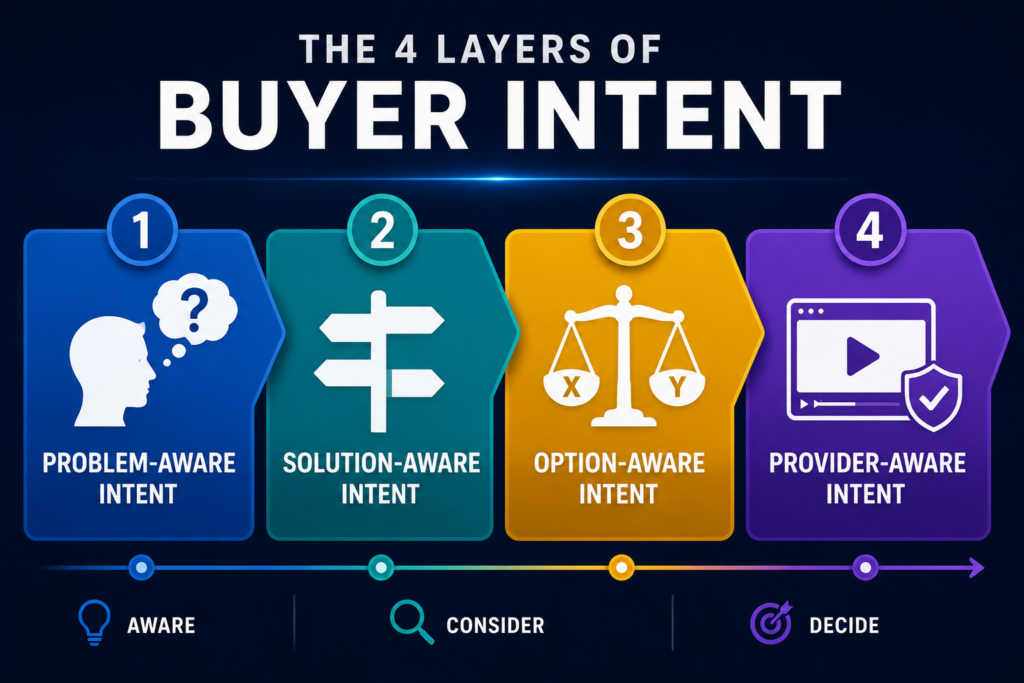
The Four Layers of Buyer Intent
Effective YouTube topic selection starts with recognizing that the same viewer shows up in very different mindsets:
1. Problem-aware intent. The viewer senses something is off but can’t name it yet. They’re asking, “Why is this happening?” Videos here help them define the problem — and associate your brand with solving it.
2. Solution-aware intent. Now they know solutions exist. They’re mapping the landscape: What are my options? What are the trade-offs? These videos orient the buyer.
3. Option-aware intent. They’re comparing, evaluating, and reducing risk — searching “X vs. Y” and “Is this worth it?” This is where decision-stage content lives, and it’s where most business channels are weakest. These topics feel narrow, but that narrowness filters out the wrong audience and concentrates the right one.
4. Provider-aware intent. The buyer knows you exist and is deciding whether you’re the right fit. They want proof, demos, process, and honesty about who you serve best.
Most channels are top-heavy: plenty of awareness content, almost nothing where buyers are actually ready to act. That imbalance is quiet — but for organizations spending at scale, it’s expensive. Any serious content strategy for business has to account for all four layers, meeting buyers where they actually are rather than where you wish they were.
Watch us break down the full framework here:
How to Choose YouTube Topics for Business: The Intent Map
If you’re wondering how to choose YouTube topics for business, this practical exercise turns a buyer intent content strategy into a repeatable process:
Step 1: Collect your topic ideas. Pull from sales calls, support conversations, and prospect questions — using the buyer’s wording, not your internal jargon.
Step 2: Sort every topic by intent level. Label each idea as problem-aware, solution-aware, option-aware, or provider-aware.
Step 3: Identify the gaps. If nearly everything sits at the top of the funnel, you’ve found why the channel isn’t moving the business. Awareness alone doesn’t close uncertainty.
Step 4: Fill the bottom of the map first. Prioritize decision-stage content — comparisons, pricing factors, product breakdowns — and provider-aware videos about your process and fit.
Step 5: Test titles against browse intent. Would the right person recognize themselves in the title if it appeared unexpectedly? A strong content strategy for business works in both search and browse.
Precision Beats Cleverness
A buyer intent YouTube strategy isn’t about being clever — it’s about being precise: precisely where buyers are, and precisely what they need next. When YouTube topic selection is mapped to intent, scripting, packaging, and measurement all become easier. When it’s wrong, the rest of the work is just polishing a topic that was never going to do the job. That’s the foundation of a YouTube content strategy that grows the business, not just the view count.
Ready to Turn Your Channel Into a Revenue Asset?
TurboRank partners with large-scale organizations to build buyer intent content strategy into every stage of their YouTube presence — from intent mapping and audience research to SEO optimization and distribution. Start with our Free Quick Fix Audit to see exactly where your channel is leaking commercial value, or contact TurboRank today to build a channel that drives measurable growth.
Frequently Asked Questions
Why do most business YouTube channels fail to drive revenue?
Because their topics aren’t mapped to buyer intent. Channels overload on awareness content while neglecting the comparison and evaluation stages where buyers actually make decisions.
What is decision-stage content on YouTube?
Videos built for buyers who are actively comparing options — comparisons, pricing breakdowns, and evaluations. They attract smaller audiences but sit closest to the purchase.
How does buyer intent apply to browse traffic, not just search?
Browse intent is slower-burning: a viewer sees a title and instantly recognizes it matters to them. Strong titles are written so the right buyer self-identifies on sight.
How often should enterprise teams audit their topic mix?
Quarterly intent-map audits work well for organizations publishing consistently, ensuring the funnel stays balanced as products and buyer questions evolve.
How can TurboRank help with our YouTube strategy?
TurboRank provides enterprise YouTube SEO and marketing services — intent-driven topic research, content planning, optimization, and distribution — for companies ready to invest seriously in YouTube as a growth channel. Our Free Quick Fix Audit is the fastest way to see where your channel stands.
Matthew Pearce has been at the forefront of YouTube growth since 2007, when he was first hired to produce viral video content. With over a decade of hands-on experience, he’s helped launch hundreds of successful YouTube channels and driven millions in direct sales through the platform. As a strategist and content developer, Matthew specializes in turning creative vision into scalable growth. He also leads a weekly YouTube series, offering marketers expert insights on emerging trends and what actually moves the algorithm.