

There’s a specific moment that hits ecommerce founders around the Q3 budget review. CAC is up again. The creative team swears the ads are strong. The media buyer has tested every audience twice. Before you blame the funnel, consider a harder possibility: the ads might be fine. The problem is that nobody told your next customer you exist, because they didn’t ask a person. They asked AI.
We see this constantly in established ecommerce brands. Budgets get reallocated, creative gets refreshed, audiences get retested, while nobody answers the questions a real AI visibility strategy depends on: Does ChatGPT know this brand exists? How does it describe us when a customer asks? And if it doesn’t mention us, who is it recommending instead?
When More Ad Spend Stops Buying More Customers Skip those questions and the CAC problem never actually gets solved – it just gets more expensive to ignore. This is the trap of ad spend vs. ecommerce brand authority: they don’t automatically travel together. You can hold a strong ROAS while remaining completely absent from the AI conversations that increasingly decide who gets considered at all. It’s also the honest answer to why ecommerce brands underperform in AI search. The weakness is rarely the product. It’s that the brand has no authority signal for AI to recommend it on.
We break down the full argument in this video:
Building AI Visibility for Ecommerce, Step by Step
Step 1: Run the credibility test. Ask ChatGPT the exact question a customer would ask – “best [your category] brands” – and see if you appear.
Step 2: Audit your citation footprint. AI builds its picture of a brand from what’s citing it across the internet, so check what AI is actually finding about yours.
Step 3: Build machine readable authority through YouTube. Full transcripts, real engagement, cross-platform citations, and topical depth are the signals AI weighs most and this is the exact model for outsmarting AI and driving visibility with YouTube strategies.
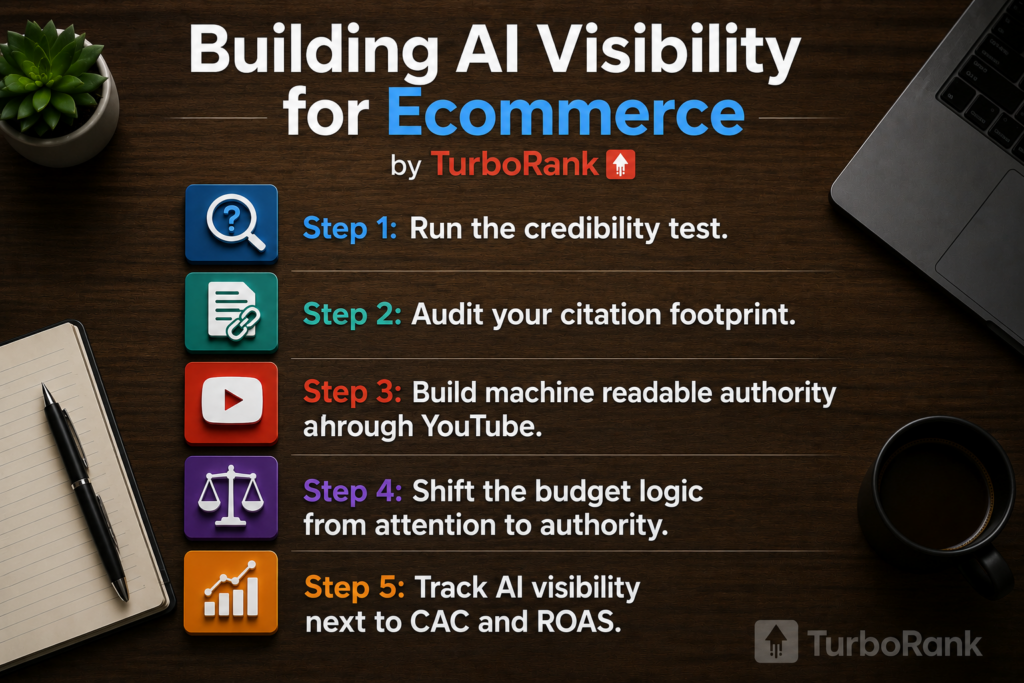
Step 4: Shift the budget logic from attention to authority. Attention is rented by the impression. Authority compounds with every piece of content that reinforces the same expertise.
Step 5: Track AI visibility next to CAC and ROAS. If it isn’t on the dashboard, it isn’t being managed.
From there, the next lever is understanding why this shift is happening, which is exactly what we unpack in the next video on why ecommerce brand authority is starting to outperform paid ads at scale.
The Attention Economy Is Over. The Authority Economy Just Started. For fifteen years, ecommerce ran on a simple logic: buy enough attention and you win. That logic is breaking down, because AI has inserted itself into the exact moment a customer decides who to trust and that decision was never for sale.
This is the deeper shift behind generative engine optimization: earning citable, consistent authority that generative AI systems recognize on their own, instead of paying for placement the way a media buy works. It’s also why ecommerce organic visibility in 2026 means something different than it did two years ago. It’s no longer just about ranking on Google. It’s about how to appear in ChatGPT and every other AI search ecommerce marketing surface your customers are already using.
Turn Invisibility Into Authority At TurboRank, we help ecommerce brands build the machine readable authority AI systems actually recognize. Our Free Quick Fix Audit shows you exactly where your brand is invisible to AI and what closing that gap looks like.
Frequently Asked Questions
Why doesn’t my ecommerce brand show up in ChatGPT?
AI recommends brands based on credibility signals gathered across the internet – citations, engagement, topical depth – not ad spend. Thin signals mean AI has nothing to recommend you on.
Is this the same thing as SEO?
No. Traditional SEO optimizes for search rankings. AI visibility depends on authority signals AI systems trust and cite, which rankings alone don’t build.
How does YouTube help with AI visibility for ecommerce?
YouTube produces crawlable transcripts, measurable engagement, cross-platform citations, and topical depth – the four signals behind machine readable authority.
How does TurboRank fit into this?
We help established ecommerce brands build AI visibility through YouTube strategy and optimization. Our Free Quick Fix Audit shows exactly where the authority gap is costing you.
Matthew Pearce has been at the forefront of YouTube growth since 2007, when he was first hired to produce viral video content. With over a decade of hands-on experience, he’s helped launch hundreds of successful YouTube channels and driven millions in direct sales through the platform. As a strategist and content developer, Matthew specializes in turning creative vision into scalable growth. He also leads a weekly YouTube series, offering marketers expert insights on emerging trends and what actually moves the algorithm.