
You can’t buy brand authority. You can buy traffic, plenty of it, but authority is something customers decide to give you. The simplest way to think about how to build brand authority is to stop asking “How do we find more customers?” and start asking “Why aren’t more customers coming to find us?”
For most established eCommerce brands, the answer is hiding in plain sight. It lives in the heads of your support team, your product people and your founder, and it rarely makes it out of the building.
That matters more every quarter. When growth slows and acquisition costs creep up, the reflex is to add another channel. Sometimes that’s the right call. But if every new customer has to be bought from scratch, you’re renting growth instead of building it.
From the Tiki Bar: The Episode Behind This Post
I’m a co-founder of TurboRank, and I filmed this one from my usual stool at the tiki bar. In about seven minutes, I unpack why authority beats traffic and where your best content is probably hiding right now.
Why Does the Same Ad Work Better for Some Brands?
Because one of those brands already has a spot in the shopper’s memory. Recognition changes an ad’s job from making a first impression to jogging a memory, and that’s a far easier job.
Picture two brands selling nearly identical $1,500 rowing machines (a made-up price, just for the example). A shopper sees an Instagram ad from each.
Brand one is a stranger. Its product page has to explain the machine, prove the company is real, handle every objection and justify the price. That’s a lot to ask of one page.
Brand two gets a second look. She watched their video on rowing form last month. Their founder answered a question in a Reddit thread she read. ChatGPT mentioned them when she asked about quiet rowers. She may not remember any of it clearly, but she knows the name.
Same ad, very different odds. eCommerce has gotten so good at performance marketing that it’s easy to forget this other half exists. If you’re weighing the two, read Brand Authority vs Paid Ads.
Brand Authority vs Traffic: Two Different Scoreboards
Traffic counts how many people show up. Brand authority is what those people already believe about you when they arrive. You’ll also hear it called digital authority, and either name works. Our guide on How to Build Digital Authority lays out the full framework.
The real gap in brand authority vs traffic is how you get each one. Traffic can be bought by the click. Authority has to be earned, one helpful answer at a time.
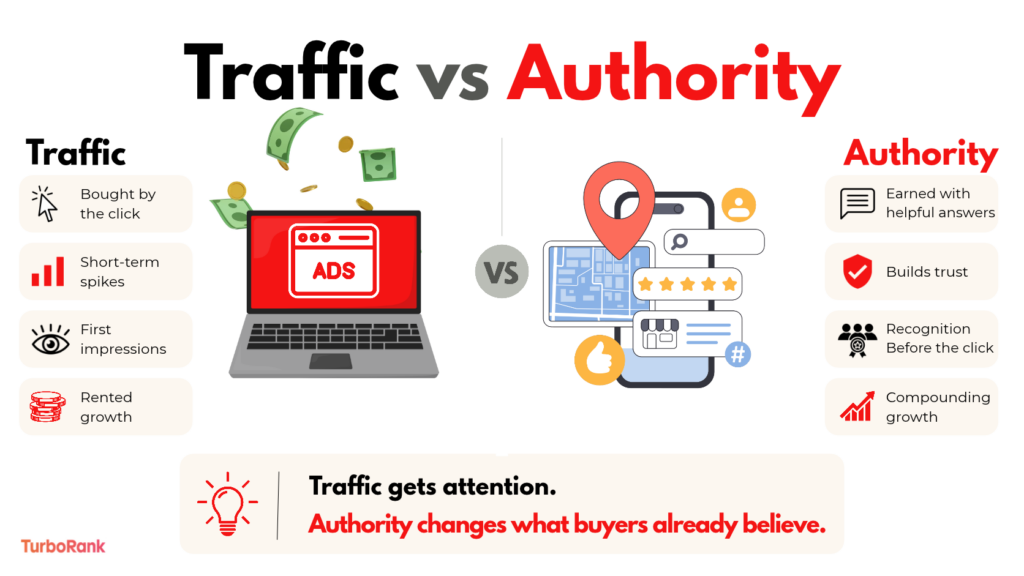
We’re not the only ones saying so. As seniorexecutive.com puts it, “Trust is hard to earn and easy to lose; the same is true of brand authority. It can’t be purchased with a bigger ad budget or manufactured through a clever campaign.”
Why should leadership care? When more shoppers arrive already halfway to yes, every paid channel pulls more weight. Over time, that’s how organic and earned demand help lower your blended customer acquisition cost.
Where Does Great Thought Leadership Content Come From?
It comes from inside your company. Most established brands don’t have a content problem. They have an expertise extraction problem: the knowledge exists, but nobody is pulling it out.
Think about who already knows what your customers need to hear:
- Customer support fields the same confused questions every week.
- Your product team knows why it was built that way, and where cheaper versions cut corners.
- Your founder has strong opinions about the bad advice in your category.
- Whoever runs pre-sale chat knows every hesitation that stalls a purchase.
- Your customers have found uses you never thought of. Read the reviews.
Where does all that gold end up? In a Slack thread nobody revisits. Meanwhile, the calendar says it’s National Pancake Day, so somebody makes a pancake graphic. That fills a slot. It isn’t a content marketing strategy.
Subject matter expert marketing means building content around what your people genuinely know. Expertise-based content marketing is more useful, harder to copy and more fun to make. It’s also the thought leadership content customers actually look for.
How to Build Brand Authority in Four Weeks
If you’re figuring out how to build brand authority for an ecommerce brand, you don’t need another brainstorm. You need a month and a few good conversations.
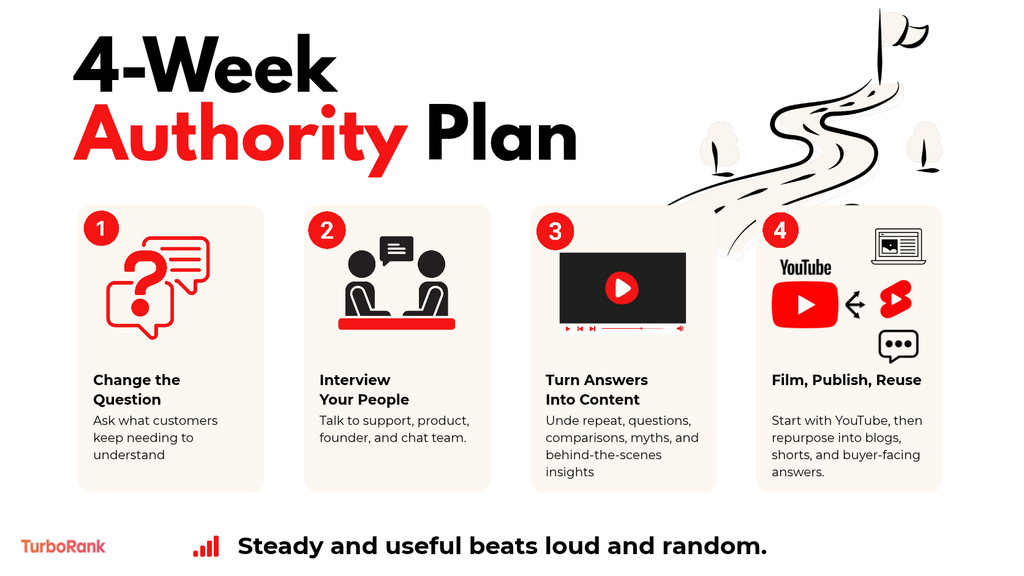
Week 1: Change the question. At your next content meeting, skip “What should we post?” and ask “What do our customers keep needing to understand?”
Week 2: Interview your own people. Grab 15 minutes each with support, product, your founder and your chat team. Ask what they answer most, what customers misunderstand and what competitors say that drives them nuts.
Week 3: Turn answers into video ideas. A repeat question becomes an explainer. A design decision becomes a behind-the-scenes story. “Why not the cheaper one?” becomes an honest comparison. Your founder’s pet peeve becomes a myth-buster, probably your best video.
Week 4: Film, publish, then reuse. Start with YouTube, then turn each video into a blog post, short clips and helpful answers where your buyers hang out. Repeat next month. Steady and useful beats loud and random.
What Does Category Authority Look Like?
Category authority is when shoppers researching your category keep running into you. They find you on Google, on YouTube, in Reddit threads, on social and in AI-generated answers, wherever they go to learn.
Notice what’s missing: views, blog traffic and posting every Tuesday because the calendar says so. The real goal is a quiet shift in the customer’s head, from “a company that sells rowing machines” to “the company that really knows rowing.” That same body of useful content also gives AI tools more to draw on, which helps your AI visibility.
And that edge is getting more valuable. According to digitalmarketinginstitute.com, “As it becomes harder to get found online due to artificial intelligence (AI) features on search engines like Google’s AI Overviews and the sheer volume of brands competing for exposure, becoming an authority can help give you a competitive edge.”
Then something nice happens to your paid media. Meta, Google, TikTok and influencers stop carrying your entire existence and start amplifying a reputation you’ve already earned. Keep the ads running. They’re brilliant at getting noticed, but they were never built to earn years of trust. More on that in Why Digital Authority Is More Important Than Advertising.
Quick Answers for Busy Founders
Is brand authority the same as brand awareness?
Not quite. Awareness means people know your name. Authority means they trust what you say about your category.
How long does it take to build brand authority?
It compounds, so think in quarters rather than weeks. Give consistent content at least 60 to 90 days before judging early traction.
Who should be on camera?
Whoever knows the answer and can explain it clearly, often your founder or a product lead. Helpful beats polished.
Start With the People Down the Hall
Next time someone pitches another channel, hear them out. Then ask what your team knows that customers don’t yet, and how to get it out there. Want to see what that looks like in practice? Check out our case studies.
Ready to talk about your brand? Book a Discovery Session by sending a quick email to hello@turborank.co. Tell us what you sell and where you’d like to show up, and we’ll find a time.

Matthew Pearce has been at the forefront of YouTube growth since 2007, when he was first hired to produce viral video content. With over a decade of hands-on experience, he’s helped launch hundreds of successful YouTube channels and driven millions in direct sales through the platform. As a strategist and content developer, Matthew specializes in turning creative vision into scalable growth. He also leads a weekly YouTube series, offering marketers expert insights on emerging trends and what actually moves the algorithm.