
Real YouTube SEO isn’t titles and tags with better keywords sprinkled on top. It starts with what people are actually searching for, checks who’s beating you to the answer, fixes the videos you already have sitting there, makes your titles and thumbnails less “internal memo” and more “actual human problem,” and ties it all together so AI tools recognize your company as the one that knows what it’s talking about.
Somewhere in your company right now, there’s a folder of beautifully produced videos getting the kind of engagement you’d normally expect from a filing cabinet. Good lighting. Real budget. An executive who practiced their lines. And a view count that makes you wonder if the “publish” button actually worked.
Here’s the thing nobody wants to hear out loud in a marketing meeting: the fix probably isn’t video #201. It’s figuring out why videos #1 through #200 are invisible.
Watch the Full Video
We cover this whole idea (from, appropriately, a tiki bar) in the video below – what YouTube SEO should actually mean for a company that already has a real library, not a blank channel.
Stop Guessing What Video to Make Next
Most companies plan videos the way you’d plan a dinner party where you only invite people you already know – nice, comfortable, and completely disconnected from who’s actually hungry. There’s a launch to announce, a quarter to celebrate, an executive who’d like some camera time. Reasonable! Also not remotely related to what your customer is typing into a search bar at 11pm trying to solve a problem.
Flip the order. Instead of running out of decent YouTube content ideas in a brainstorm that goes in circles, just ask your sales team what customers ask them, every single week, on repeat. That list is your content calendar. It already has an audience. It’s just been sitting in your CRM instead of on your channel.
The Actual Checklist (No, Not Just Tags)
If someone’s pitching you “YouTube SEO services” and the pitch stops at titles and descriptions, that’s like hiring a personal trainer who only talks about your gym socks. Sure, nice socks matter. They are not the workout. A real engagement should look a lot less like a quick metadata cleanup and more like an actual audit of why your channel isn’t showing up where your buyers already are. Here’s what should actually be on the table, in roughly the order it should happen:
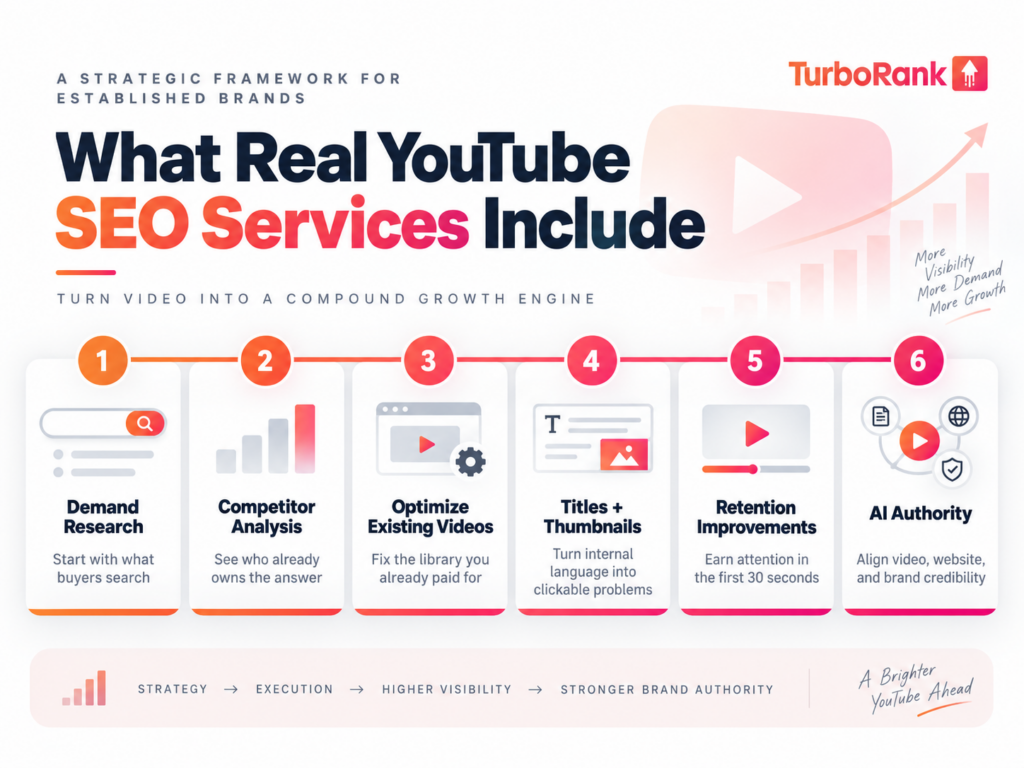
- Real demand research – every video should answer something people are genuinely searching for, not something your org chart wanted said out loud.
- A look at your competitors – who’s already answering your buyer’s questions on YouTube, and why does it keep being them?
- Fixing what you’ve already got – this is the part everyone skips. Most companies asking about how to rank videos faster are sitting on the answer already: solid videos wearing a terrible title like a bad Halloween costume.
- Titles and thumbnails a human would click – “Q3 Innovation Series, Part 4” is not a hook. It’s a nap.
- Retention – if your video opens with 45 seconds of “we’re so excited you’re here,” you’ve lost half your audience before you’ve said anything useful. That’s not a guess: vidIQ’s retention research found a strong opening keeps 60%+ of viewers past the 30-second mark, while a slow, branded cold open – their words, “a logo animation or ‘hey guys, welcome back’ preamble” – is one of the most common ways channels burn that same window before the content even starts.
Your Competitor Isn’t Just Winning Views – They’re Winning the Conversation
None of this matters in a vacuum, by the way. You’re not just optimizing against an algorithm – you’re optimizing against an actual company with an actual marketing budget, and they’d love it if you kept ignoring this. While you’re deciding whether any of this is worth the effort, somebody else in your category is already doing it, quietly, one video at a time. Here’s a fun (read: mildly horrifying) exercise to see where you actually stand. Take the top five questions your sales team hears on every single call. Go search each one on YouTube. Whoever shows up first is talking to your prospect before you are – politely, helpfully, and completely uninvited.
Do that across enough questions and it stops being an “SEO thing.” It turns into an actual market share war, quietly fought and often lost in search results, months before either company’s sales team even picks up the phone. And here’s the annoying part: any competitor can run this exact same search on you. So can you fix it once and forget it? Nope. Check it the way you’d check the mail – regularly, and slightly annoyed that you have to. It’s not glamorous work, but it’s a lot cheaper than finding out the hard way, in a lost deal or a quiet no-reply email, that someone else got there first.
The Fancy Part: AI Authority
Okay, one more layer, and then you can go back to whatever you were doing. Once your videos, website, and executives all say the same smart thing about your expertise, something interesting happens: AI tools start noticing too. This isn’t just a vibe – Gartner predicts traditional search engine volume will drop 25% by 2026 as those queries shift to AI chatbots and other virtual agents. Buyers are already asking chatbots the same questions they used to type into Google, and those tools tend to recommend whoever looks the most consistently credible across the internet – not just whoever ranks #1 on one platform. It’s less like winning a game and more like being the person at the party everyone agrees actually knows what they’re talking about.
That’s the whole idea behind How to Build Digital Authority – it’s less about winning a single ranking and more about becoming the obvious, trustworthy answer wherever someone happens to be asking the question. Gartner’s own researchers put it plainly: as generative AI floods the internet with content, “content should continue to demonstrate search quality-rater elements such as expertise, experience, authoritativeness and trustworthiness” to actually stand out (Gartner). A great video helps. A great video that agrees with your website and your CEO’s LinkedIn posts is what actually sticks.
FAQ
Should we make more videos or fix the ones we have?
Fix what you have. It’s already paid for, and it’s usually the fastest win on the table.
Why does YouTube SEO matter separately from regular SEO?
Because YouTube cares about whether people actually stick around and watch – not just whether the title has the right keyword in it. As YouTube creator liaison Matt Koval has put it, “[YouTube’s] search and discovery system loves videos that people have found satisfying, and a great way it determines that is audience retention” (via vidIQ).
What’s “AI Authority” in plain English?
It’s making sure your video, your website, and your execs aren’t accidentally contradicting each other, so AI tools (and humans) trust what they find.
Before You Book Video #201
Most 200-video channels don’t have a content problem. They have a “nobody ever went back and fixed anything” problem. If that sounds familiar, we’ll help you find exactly where the gaps are – grab a Free Quick Fix Audit or just email hello@turborank.co.

Matthew Pearce has been at the forefront of YouTube growth since 2007, when he was first hired to produce viral video content. With over a decade of hands-on experience, he’s helped launch hundreds of successful YouTube channels and driven millions in direct sales through the platform. As a strategist and content developer, Matthew specializes in turning creative vision into scalable growth. He also leads a weekly YouTube series, offering marketers expert insights on emerging trends and what actually moves the algorithm.