
Every company has expertise. Almost none of them have digital authority – and that gap is quietly costing market share long before a deal ever appears in a CRM. It’s exactly why companies lose market share without losing a single quoted opportunity: expertise lives inside the business instead of inside the buyer’s mind.
This Executive Briefing breaks down how to build digital authority using a five-part operating system – not a content calendar, not an SEO checklist, but a repeatable digital authority strategy for turning expertise into trust, and trust into growth.
Expertise Isn’t the Same as Authority
Companies assume that because they have expertise, the market automatically sees them as the experts. It doesn’t. Expertise exists inside your company. Authority exists inside your customer’s mind – and that’s where the gap actually lives.
This distinction matters more than most B2B marketing strategy decks admit. Thought leadership and brand authority aren’t built by publishing more – they’re built by making expertise visible and impossible to ignore, to buyers, search engines, and AI alike.
“Companies assume that because they have expertise, the market automatically sees them as the experts. It doesn’t. Expertise exists inside your company. Authority exists inside your customer’s mind – and that’s where the gap actually lives.
This distinction matters more than most B2B marketing strategy decks admit. Thought leadership and brand authority aren’t built by publishing more – they’re built by making expertise visible and impossible to ignore, to buyers, search engines, and AI alike.” – Brixon Group
That number has climbed steadily from the 57% researchers first clocked back in 2015 – and it means most of the buying decision now happens before sales is ever in the room. That’s exactly why digital authority is more important than advertising for considered-purchase brands.
How to Build Digital Authority: The 5-Part Framework
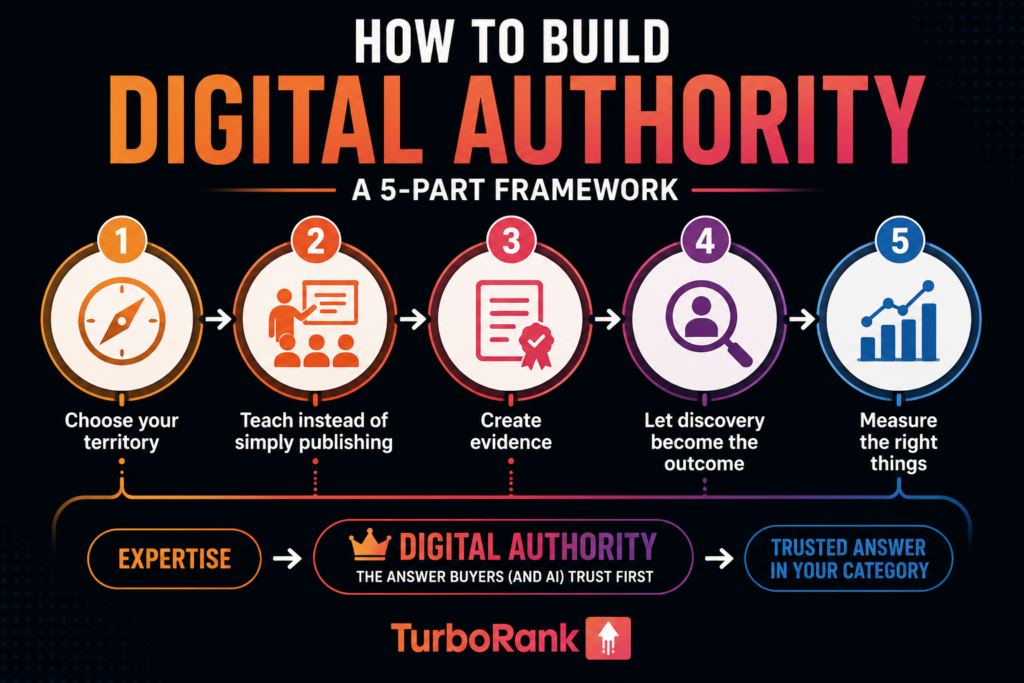
Turning expertise into authority isn’t a content strategy or a marketing framework you bolt onto existing efforts. It’s an operating system with five parts.
- Choose your territory. Most companies try to own everything. Category leaders choose one conversation and become synonymous with it – this is category leadership in practice. If competitors define the conversation, they’ll eventually define the category.
- Teach instead of simply publishing. Publishing creates activity; teaching creates authority. Dozens of educational assets answering real customer questions build the knowledge depth that turns content into authority marketing.
- Create evidence. Authority isn’t claimed, it’s demonstrated. Every case study, demo, and executive interview becomes evidence buyers evaluate, search engines understand, and AI can reference.
- Let discovery become the outcome. When authority compounds, customers and AI tools start finding you – and paid media works far better, since ads now introduce buyers to a company that’s already trusted.
- Measure the right things. Views and clicks aren’t enough. Track how often AI includes your company, how many buying questions your brand owns, and how much trust exists before prospects contact sales.
“By 2026, traditional search engine volume will drop 25%, with search marketing losing market share to AI chatbots and other virtual agents.” – Gartner, Inc.
That shift is why AI visibility and AI search now belong on the same scorecard as rankings and traffic. A search everywhere optimization approach – YouTube, Google, and AI answers together – is becoming the baseline for demand generation, not a side experiment.
Why This Beats a Bigger Ad Budget
Products can be copied. Pricing can be matched. Technology eventually catches up. Authority is much harder to replicate, which makes it a durable competitive advantage rather than a campaign line item. That’s the thinking that separates executive strategy from tactical marketing leadership – and why the companies that win the next decade won’t just compete for customers. They’ll compete to become the company customers, and AI, recommend first.
If you’re wondering where your own company stands today, that’s exactly why we built the TurboRank Digital Authority Assessment – it shows you where your authority already exists, where the gaps are, and where your biggest opportunities are hiding.
Want a faster read on where you stand? Email us directly at hello@turborank.co, or grab our Free Quick Fix Audit and we’ll show you exactly where the gaps are.
FAQ: Building Digital Authority
What is digital authority, and how is it different from thought leadership?
Thought leadership is one input. Digital authority is the outcome: compounding, measurable trust across YouTube, Google, and AI search until buyers and algorithms treat you as the default answer in your category.
How to become an industry authority if we’re starting from zero?
Start with territory, not tactics. Pick the one conversation you want to own, then teach consistently against real buyer questions – depth beats volume.
How do we measure digital authority instead of just marketing metrics?
Go beyond views and traffic. Track branded search volume, share of voice, how often your brand is cited in AI answers, and how much trust exists before a prospect reaches sales.
Where should a company start building AI visibility today?
Identify the buying questions your category already searches for, then build evidence – demos, data, customer stories – that search engines and AI systems can confidently cite.

Matthew Pearce has been at the forefront of YouTube growth since 2007, when he was first hired to produce viral video content. With over a decade of hands-on experience, he’s helped launch hundreds of successful YouTube channels and driven millions in direct sales through the platform. As a strategist and content developer, Matthew specializes in turning creative vision into scalable growth. He also leads a weekly YouTube series, offering marketers expert insights on emerging trends and what actually moves the algorithm.